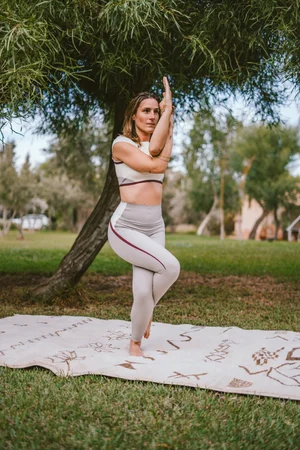
Kundalini. I didn't find it. It found me.
I've known since I was a child that something was moving inside me — an energy I couldn't name, couldn't contain, and for most of my life couldn't direct. I ran after everything, burned through everything, and wondered why I was always rather excited or absolutely exhausted.
In 2019, I put a word on it. Kundalini.
It took me seven more years to fully commit to the practice. Not because I doubted it — but because this kind of energy demands that you're ready. And ready takes time.
So what is Kundalini?
The Sanskrit word kundala means "circular" or "coiled" — as in a ring, a bracelet, a coil of rope. Not a monster. Not a danger. A shape. A potential.
Kundalini is considered the mother of all yogas — the root from which every other practice draws its power.The earliest references to this energy appear in the Upanishads — sacred texts dating back to around 1000 BCE — which describe energy centers and spiritual practices that form the foundation of what we now call Kundalini.
Kundalini is a dormant life force resting at the base of the spine. When it awakens, it rises through the chakras — the body's energy centers — sparking transformation, clarity, and a deeper connection to yourself.
This is not a trend. For centuries, these teachings were kept as a secret oral tradition, passed from teacher to student within specific lineages. What we practice today is a living transmission of something very old.
Is it dangerous?
This is the question people always ask. The honest answer: uncontrolled energy in an unprepared body can be destabilizing — the same way electricity is dangerous if you don't know how to channel it.
Kundalini as a discipline is the opposite of dangerous. It's a daily practice — kriyas, pranayama, meditation, mantra — designed to open the channels progressively, with rigor and gentleness. The nervous system is prepared. The energy moves with structure, not chaos.
What generates the "dangerous" reputation is usually the opposite of practice: forced awakening, no preparation, no grounding, no lineage.
Some practices promise you an awakening delivered by someone else's hands. Kundalini yoga is not that. Nobody activates this for you. You do the work, and the energy responds.
I've been practicing for years now. I'm still in the middle of it — 250 hours of Kundalini teacher training at KRY Ashram in Sintra, a morning sadhana that doesn't move regardless of what life throws at it, and a steadily quieter mind.
What I can tell you is this: the energy was always there. It just needed a container strong enough to hold it.
That's what the practice builds. Not enlightenment. A container.